Why do we keep adding a button to AI?
On the feeling of certainty in interaction, the unnecessary distance between people and models, and why “just say it” has not become the default yet.
 白子诩lab
Continuously updated
This is Baizixu’s personal space: observations beyond code, tools I keep reusing, and experiments still growing.
Jot down a transaction and always see where the money goes
01 / PROJECTS

Upload a photo, pick a garment and generate a 10-second try-on video.
Practise comprehension, memory and expression with 850 basic words.
Test your reaction, memory and attention with short brain games.

Save the current page to a chosen bookmark position in one click.
02 / GAME LAB
Turning rules, feedback and a little joy into playable things: small games, interaction experiments and prototypes.
 Explore
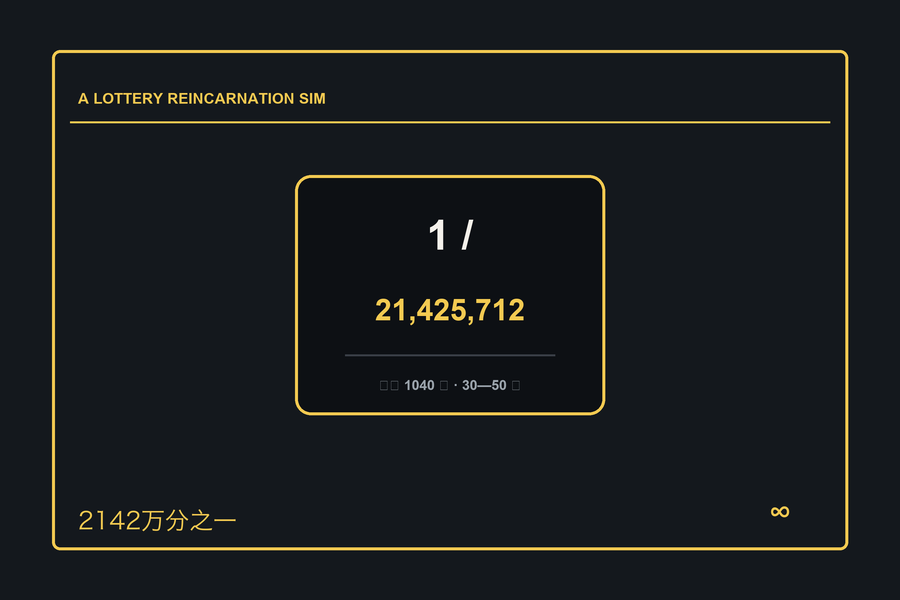
The jackpot odds are 1/21,425,712 at 2 yuan per ticket. Set how often you buy per week, how many tickets each time and your age range, then simulate N parallel worlds to see how much you spend and how long it takes to win once.
 Explore
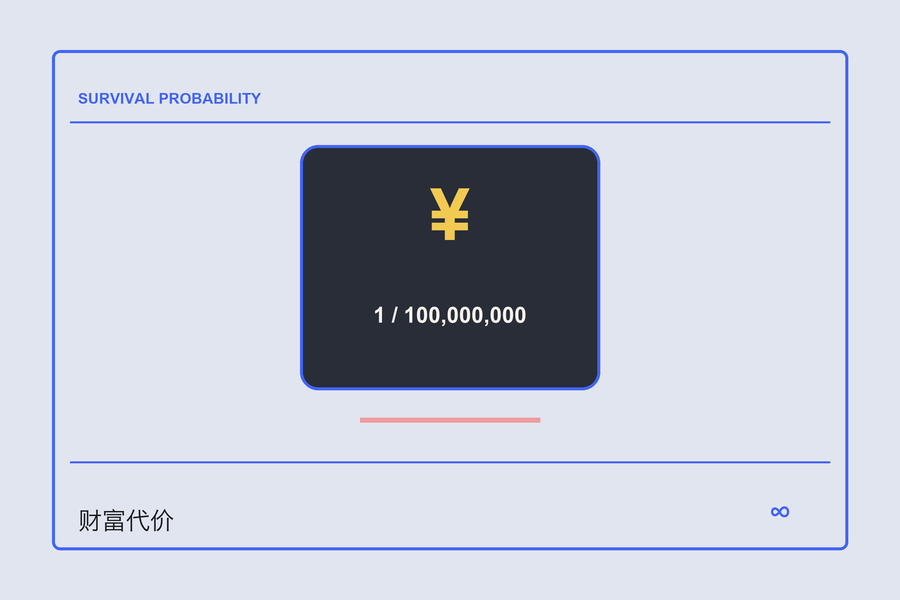
You gain 100 million yuan every millisecond, but each second there is a one-in-a-hundred-million chance of immediate death. See how long you last across a crowd of parallel worlds.
 Explore
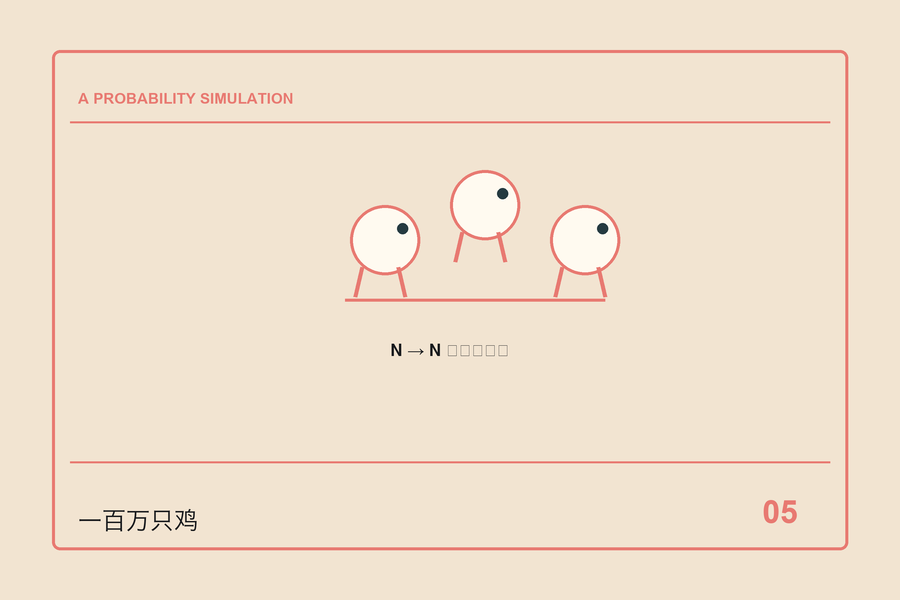
Each time, pick a random chicken that still has legs and cut off one leg. See how many intact chickens remain.
03 / LIBRARY
Books, films, music and games I have been through. Not a scoreboard, but a record for my future self.
E. T. Jaynes starts from the idea that probability is extended logic and places probability theory and statistical inference inside a single reasoning framework, asking how sound judgements can be formed from incomplete information. The book lays out the logical foundations of Bayesian methods and applies them to physics, mathematics, economics, chemistry and biology — a work on probabilistic reasoning for advanced undergraduates, graduate students and researchers.
E. T. JaynesStarting in 1964, British documentary director Michael Apted followed children from different social classes, revisiting them every seven years to record the choices, difficulties and life paths that carried them from childhood into adulthood.
Michael AptedA classic work of social psychology explaining why we say yes. Starting from six common principles — reciprocity, commitment and consistency, social proof, liking, authority and scarcity — Cialdini takes apart the persuasion mechanics in advertising, sales, relationships and everyday decisions, and reminds us to notice the psychological triggers we tend to overlook.
Robert Cialdini04 / ONLINE TOOLS
Everyday small actions turned into tools you can open and use. Nothing uploaded, nothing saved, kept light on purpose.
Convert between plain text and Base64 strings.
Tiny Tool · ColorConvert quickly between RGBA values and HEX color codes.
Tiny Tool · JSONTurn minified JSON into a readable structure, and check syntax quickly.
Tiny Tool · DigestGenerate an MD5 digest for a piece of text.
Tiny Tool · QR CodeTurn text or a link into a QR code you can save.
Tiny Tool · ColorGenerate a random color each time, showing both HEX and RGB values.
Tiny Tool · TimeConvert quickly between Unix timestamps and local date and time.
MORE TOOLSOpen the toolbox and keep exploring small tools you can use right away.
05 / EXTERNAL LINKS
Saving a link is not hoarding — it is a signpost for future me.
06 / WORDS
On the feeling of certainty in interaction, the unnecessary distance between people and models, and why “just say it” has not become the default yet.
It is not about finishing every feature, but knowing what can be left out.
Good design starts with an honest attitude toward details.
Give memory a place to land, and there is room left to think.
07 / IDEAS
Keep the fleeting thoughts first, without rushing to prove them. They become references for future products, essays or experiments.
Use isolated, forced-diverse families of simulated strategies to observe market states in a daily competition with no look-ahead data; the output is a risk signal for trend, chop or panic — never a buy or sell instruction.
A long-term documentary that revisits ordinary Chinese lives every seven years, observing how people grow, drift, choose and are chosen in the river of their times.
08 / ABOUT
I like turning vague curiosity slowly into things you can visit: writing, building tools, collecting links, and running weekend experiments that are not always useful but always fun.
About BaizixuKEEP IN TOUCH
KEEP IN TOUCH
Open to interesting small collaborations
bai.zixu@foxmail.com